
A missed call text back is an automatic SMS sent shortly after an unanswered call, keeping the lead warm before they ring your competitor. If you're a tradie, salon owner, or service contractor in Australia, set one up now. Here's where to start:
- Choose your trigger window. Set the SMS to fire after 30–60 seconds of no answer, giving you a chance to pick up first.
- Pick a provider or engage Munyal. Look for Australian sender ID support, two-way messaging, and delivery receipts. Munyal builds bespoke systems tailored to your business style.
- Publish one template and test it. A single, conversational message with your business name and a clear next step is enough to get live.
About 85% of callers who do not get an immediate response will not call back, which means every unanswered call is a significant lost lead without a recovery system in place. The sections below cover the full setup path: how it works, ready-to-use templates, provider selection criteria, Australian compliance obligations under the Spam Act 2003, and how to measure results.
Table of Contents
- Why does missed-call text back recover more leads than voicemail?
- When does text-back deliver the biggest uplift for your business?
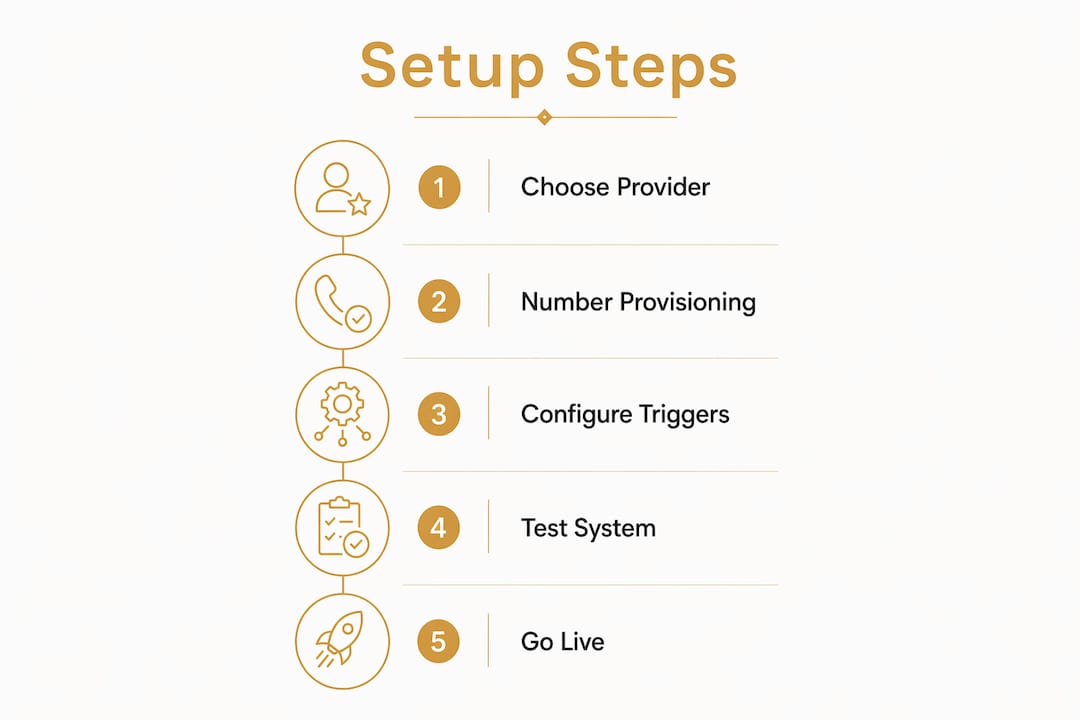
- How do you set up a missed-call text-back system step by step?
- What should your missed-call text messages actually say?
- Which provider features should you require before signing up?
- What are your legal obligations under Australian SMS law?
- How do you measure whether text-back is actually recovering leads?
- How Munyal implements missed-call text-back: a founder-led case study
- Key takeaways
- Why quick replies win jobs: a note from Tyson
- What Munyal's missed-call text-back service includes
- Useful sources for compliance and provider due diligence
Why does missed-call text back recover more leads than voicemail?
The answer is friction. Voicemail asks a caller to wait, listen, and then decide whether to leave a message or call back later. A text lands on their lock screen within seconds and asks for nothing more than a quick reply. That difference in effort is the whole game.
Many callers who reach voicemail or a busy signal won't try again. A text-back intercepts that drop-off before it happens, converting what would have been a lost lead into an active SMS conversation that can be qualified and scheduled.
A few behavioural reasons this works so consistently:
- Immediacy. The message arrives while the caller is still thinking about their problem, not an hour later when they've already booked someone else.
- Lower friction. Replying to a text takes five seconds. Calling back takes nerve, time, and the willingness to go through hold music again.
- Lock-screen visibility. SMS open rates dwarf email. The message is seen, usually within minutes.
- Asynchronous convenience. The caller can reply when it suits them. You can respond when you're off the tools. Neither party needs to be available at the same moment.
For trades specifically, a missed call converted to a booked job within minutes is a realistic outcome when the text-back fires quickly and the message is clear. The speed-to-lead window for service enquiries is short. A text that arrives in under a minute keeps you in the running; silence hands the job to whoever answers next.
When does text-back deliver the biggest uplift for your business?
Not every business gets the same return, but the pattern is consistent: the higher the cost of a missed booking, the more a text-back earns its keep.
High-impact situations:
- During work hours when staff are on jobs. A plumber on-site, an electrician in a switchboard, a builder mid-pour — none of them can answer a call. A text-back means the enquiry doesn't evaporate.
- After hours. Callers at 7 PM or on a Sunday aren't expecting a live answer, but they do expect acknowledgement. An after-hours text sets expectations and captures the lead overnight.
- High-volume periods. School holidays, storm season, pre-Christmas rushes — when call volume spikes, so does the chance of missing enquiries. Automated responses handle overflow without adding staff.
- Public holidays. Callers often forget it's a holiday. A text that says "we're closed today but open tomorrow at 7 AM" prevents the lead from going cold.
Industries where it matters most:
- Trades (plumbers, electricians, HVAC, builders). Average job values are high and callers are often in urgent need. Losing one job to a competitor because you didn't answer costs real money.
- Salons and beauty clinics. Appointment-based revenue means every missed booking call is a direct revenue miss. A text with a booking link recovers many of those without any staff involvement.
- Allied health and wellness practitioners. Similar to salons, but with the added consideration that some regulated services may have restrictions on what automated messages can say. Check with your professional body before setting up.
- Transport and delivery services. High call volumes and mobile operators who can't answer while driving make text-back a natural fit.
Where it's less useful: highly regulated phone lines where privacy rules restrict outbound SMS (some financial services, certain health contexts) may need legal review before deploying automated text responses. When in doubt, check with a solicitor familiar with your industry's obligations.
Pro Tip: If your business takes emergency calls (burst pipes, electrical faults, lockouts), add a second message variant for after-hours that explicitly acknowledges urgency and gives a direct callback number or emergency contact. A generic "we'll be in touch" won't cut it at 11 PM.
How do you set up a missed-call text-back system step by step?

The quickest path to live: choose a provider, connect your number, write one message, and test it from a mobile. Most setups take 24–72 hours end to end.
Step-by-step setup
- Choose your route. Decide between a self-serve platform, an integrated business phone system, or a bespoke build like Munyal's missed-call text-back system. Bespoke suits businesses that want tone-matched messaging, booking integrations, and compliance handled from day one.
- Map your phone number options. You can use a dedicated virtual number (DID), port your existing mobile, or connect a landline via a VoIP bridge. Virtual numbers are fastest to provision and easiest to configure triggers on.
- Set your trigger timing. 30–60 seconds is the standard window. This gives you a chance to answer manually before the SMS fires, while still catching the lead before they move on.
- Decide on one-way vs two-way SMS. One-way sends the message and stops. Two-way lets the caller reply, creating a conversation thread you can manage from a dashboard or app. Two-way is almost always worth it for service businesses.
- Set up routing. Decide where inbound replies land: a shared team inbox, your CRM, a booking system, or an email notification. The simpler the routing, the faster your team responds.
- Write your first message. One template is enough to go live. Keep it under 160 characters if possible, include your business name, and end with a clear next step (a booking link, a request for details, or a callback time).
- Test before going live. Call your number from a personal mobile, let it ring out, and confirm the text arrives. Check the opt-out path works. Test from a different carrier if possible (Telstra, Optus, Vodafone all handle SMS slightly differently).
Decision criteria when choosing a provider
- Australian sender ID support and registration capability (critical from 1 July 2026)
- Two-way messaging with a usable inbox
- Delivery receipts so you know the message reached the customer
- Integration with your booking system, calendar, or CRM
- Pricing model: per-message versus flat monthly (flat monthly is usually better for consistent call volumes)
- Local support and response times
Typical costs and timeline
Self-serve platforms generally have monthly costs suitable for small business volumes. Bespoke systems like Munyal's include setup, configuration, and ongoing support under a fixed-fee-plus-monthly model. Most businesses are live within 24–72 hours of starting setup.
Common technical issues
- Delivery failures. Usually caused by an unregistered sender ID or carrier filtering. Register your sender ID and test across multiple carriers.
- Trigger not firing. Check that the call detection logic is correctly configured for your number type. VoIP and landline integrations sometimes need additional configuration.
- Number porting delays. Porting an existing number can take 2–5 business days. Use a new virtual number to go live immediately, then port later.
- Opt-out not functioning. Test the STOP reply path before going live. A broken opt-out is a compliance risk under the Spam Act 2003.
| Setup phase | Typical timeframe |
|---|---|
| Provider selection and sign-up | 1–2 hours |
| Number provisioning (new virtual number) | Minutes to 1 hour |
| Message writing and trigger configuration | 1–3 hours |
| Testing and go-live | 1–2 hours |
| Total (bespoke build, e.g. Munyal) | 24–72 hours |
Pro Tip: Run your first test call at the same time of day you'd expect real enquiries. If your trigger is set to fire only after hours, you won't catch a misconfiguration until a real lead slips through.
What should your missed-call text messages actually say?
Length, tone, and the next step are the three variables that determine whether a caller replies or ignores you. Keep messages under 160 characters where possible, write the way you'd speak to a customer face-to-face, and always include your business name so the recipient knows who's texting them.

Conversational, authenticated messages with a clear next step consistently outperform robotic auto-replies. "Hi, it's Sarah from Bright Plumbing — sorry we missed you, can I help?" beats "Your call has been received. A representative will contact you shortly."
Ready-to-use templates
General first response
Hi, it's [Business Name] — sorry we missed your call! Reply here or book online: [link]
Booking request (salons, clinics)
Hey, [Business Name] here. We missed you! Tap here to grab a time that suits: [booking link]
Urgent trade response (plumbing, electrical)
Hi, [Business Name] here — missed your call. If it's urgent, call [emergency number]. Otherwise reply and we'll get back to you shortly.
After-hours autoresponder
Thanks for calling [Business Name]! We're closed right now but open at [time]. Reply here or book at [link] and we'll confirm first thing.
Short voicemail-to-text variant
[Business Name] here — missed you. What can we help with?
Personalisation tokens to use
[First Name]— if your system captures caller ID and can match it to a contact record[Business Name]— always include this; callers need to know who's texting[Booking URL]— direct link to your calendar or booking page[Callback time]— set a realistic expectation ("we'll call back within 2 hours")[Estimated wait]— useful during peak periods
Pro Tip: A/B test a short version (under 100 characters, no link) against a slightly longer version with a booking link. Measure reply rate and booking conversion over two weeks. Trades often see higher reply rates from the short version; salons tend to convert better with the booking link included.
Which provider features should you require before signing up?
The feature list matters more than the price. A cheap platform that drops messages or can't handle opt-outs will cost you more in lost leads and compliance risk than a well-configured system costs per month.
Feature checklist
- Two-way SMS. One-way is a dead end. Two-way turns a text-back into a conversation and lets you qualify the lead without a phone call.
- Dedicated number vs shared short code. A dedicated number (your own virtual DID) means replies come back to you, not a shared pool. Short codes are fine for bulk marketing but poor for service conversations.
- Delivery receipts and reporting. You need to know the message reached the customer's handset, not just that it left your platform. This matters especially for on-site trades where confirming receipt is part of the job record.
- Integrations. Calendar, CRM, and booking system connections mean replies and bookings flow into your existing workflow without manual data entry.
- API and webhooks. If you want to connect the system to other tools (quoting software, job management apps), API access is non-negotiable.
- Opt-out and STOP handling. The system must automatically process STOP replies and suppress future messages to that number. This is a legal requirement, not a nice-to-have.
- Sender ID registration support. From 1 July 2026, unregistered sender IDs will be labelled "Unverified" on recipients' phones, which signals a potential scam. Your provider must support ACMA sender ID registration.
- Local support and SLAs. Australian business hours support matters when something breaks on a Monday morning and you're losing enquiries.
Provider category comparison
| Feature | Entry-level field apps | Integrated platforms | Bespoke systems (e.g. Munyal) |
|---|---|---|---|
| Two-way SMS | Sometimes | Usually | Yes |
| Dedicated number | Rarely | Often | Yes |
| Delivery receipts | Basic | Yes | Yes |
| Booking/CRM integration | Limited | Yes | Custom-built |
| Sender ID registration | Self-managed | Varies | Handled for you |
| Compliance support | None | Basic | Included |
| Setup support | DIY | Guided | Founder-led |
Australia-specific note: ACMA's sender ID register opened to businesses ahead of the 1 July 2026 deadline. If your provider cannot register your sender ID on your behalf, you'll need to contact a certified telecommunications provider directly. Messages sent without a registered sender ID will appear in an "Unverified" thread on recipients' phones, which ACMA warns signals a possible scam to the recipient.
What are your legal obligations under Australian SMS law?
Businesses sending automated text messages in Australia are strictly liable under the Spam Act 2003. Outsourcing to a provider does not transfer that liability. If your system sends a non-compliant message, the obligation sits with you, not your vendor.
Compliance checklist
- Consent. You need either express consent (the caller opted in) or inferred consent (they called you, creating a reasonable basis to respond). A missed-call text-back to someone who just rang your business number generally qualifies as inferred consent, but document your reasoning.
- Sender identification. Every commercial electronic message must include accurate sender information — your business name at minimum.
- Functional opt-out. Include a STOP instruction in your messages or ensure your system processes STOP replies automatically. The opt-out path must work; test it.
- Act on unsubscribe requests within 5 business days. This is a hard requirement under the Spam Act. Suppress the number and keep a record.
- Keep consent records. If ACMA investigates, you need to demonstrate consent. A log of inbound calls and sent messages is your baseline record.
- Register your sender ID. From 1 July 2026, branded sender IDs must be registered with ACMA's SMS Sender ID Register. Unregistered IDs are labelled "Unverified."
- Vendor due diligence. Review your provider's data storage location, security standards, consent tracking capability, and unsubscribe handling. Liability cannot be delegated to a third party, so include compliance obligations in your service contract.
Key compliance principle: Under the Spam Act 2003, the business that sends a commercial electronic message bears the full burden of establishing consent and maintaining records. Relying on a third-party provider to manage compliance without contractual safeguards and regular audits is a known enforcement risk — ACMA has issued infringement notices to businesses that delegated compliance and assumed it was handled.
For privacy obligations beyond the Spam Act, the Office of the Australian Information Commissioner (OAIC) publishes guidance on handling personal information collected through automated systems. Review the OAIC's APP guidelines if your system stores caller data.
This article is general information, not legal advice. Confirm your obligations with a qualified solicitor or review the primary sources directly for your specific situation.
How do you measure whether text-back is actually recovering leads?
Start with five metrics. You don't need a complex dashboard in the first month — you need enough data to know whether the system is working and which message variant performs better.
Core KPIs
- Reply rate. SMS replies as a percentage of auto-texts sent. Aim for 20–40% in the first month as a reasonable starting benchmark.
- Call-back conversion. Bookings or jobs confirmed from text conversations. This is the number that tells you whether replies are turning into revenue.
- Lead recovery rate. Calls recovered (led to a booking or callback) as a percentage of total missed calls. Use the 85% lost-lead baseline as context: if you were losing most missed calls before, even a 30% recovery rate is a meaningful gain.
- Time to first response. How quickly the text fires after the missed call. Under 60 seconds is the target; anything over 5 minutes loses the urgency advantage.
- Cost per recovered lead. Monthly platform cost divided by the number of leads recovered. For trades averaging $1,500–$3,000 per job, recovering even one or two extra jobs per month typically covers the cost many times over.
Simple benchmarks and reporting cadence
| Metric | Early benchmark to aim for | Reporting cadence |
|---|---|---|
| Reply rate | 20–40% of texts sent | Weekly |
| Call-back conversion | — | Weekly |
| Time to first response | Under 60 seconds | Check on setup day, then monthly |
Check results daily for the first week to catch any delivery issues or trigger misconfiguration. After that, weekly is enough. If reply rate is below 15% after two weeks, test a shorter message variant. If conversion from reply to booking is low, check whether your message includes a clear next step (booking link, callback time, or a direct question).
A/B testing is straightforward: run message A for two weeks, switch to message B, compare reply and booking rates. One variable at a time — length, call to action, or tone — so you know what moved the needle.
How Munyal implements missed-call text-back: a founder-led case study
Most automated SMS tools are configured once and left to run. Munyal's approach is different: every system is built by founder Tyson Kaye, who maps the business's tone, workflow, and customer type before writing a single message.
The Munyal process
- Discovery. Tyson reviews the business's call patterns, peak hours, and existing customer communication style. The goal is a system that sounds like the business, not a generic bot.
- System design. Trigger timing, message variants, routing rules, and integration points (booking system, CRM, job management app) are mapped before any configuration begins.
- Build and test. The system is configured, tested across multiple carriers, and validated for compliance — sender ID registration, opt-out handling, and consent documentation included.
- Go-live and optimisation. Munyal monitors early performance, adjusts message variants based on reply and conversion data, and provides ongoing support under the monthly subscription.
Lava Operations: before and after
Lava Operations, a trades business, engaged Munyal to address a consistent pattern of missed calls during peak shift hours. Before the system, calls that went unanswered during jobs were effectively lost. After Munyal implemented a trigger-based text-back with a booking link and a two-way SMS inbox, the business began recovering enquiries that previously resulted in silence.
The value of founder involvement is specificity. An off-the-shelf template might say "Thanks for calling, we'll be in touch." A Munyal-built message says something that matches the business's voice, references the right next step, and is configured to fire at the right moment. That difference shows up in reply rates.
To book a discovery call with Tyson, visit Munyal's missed-call text-back page and have the following ready: your current call volume, your peak missed-call hours, and the booking or job management system you use.
Key takeaways
A missed-call text-back system recovers leads that would otherwise be lost permanently — but only when the trigger is fast, the message sounds human, and the compliance foundations are in place.
| Point | Details |
|---|---|
| Speed is everything | Set your trigger to fire within about a minute; anything slower loses the urgency advantage. |
| One template is enough to start | Write one conversational message with your business name and a clear next step, then test and iterate. |
| Sender ID registration is now mandatory | From mid-2026, unregistered sender IDs are labelled "Unverified" by Australian carriers — register before going live. |
| Compliance sits with you | The Spam Act 2003 requires consent, sender identification, and a functional opt-out; outsourcing doesn't transfer liability. |
| Munyal builds bespoke systems | Munyal's founder-led approach covers setup, tone-matching, compliance, and ongoing optimisation for Australian service businesses. |
Why quick replies win jobs: a note from Tyson
The businesses that grow fastest aren't always the best at their trade. They're the ones that respond first. A caller who gets a text within 30 seconds of hanging up knows they've been acknowledged — and that feeling of being seen is often enough to keep them from ringing the next number on the list.
What I've found building these systems for Australian service businesses is that tone matters as much as timing. A message that sounds like a real person from a real business gets replies. A robotic acknowledgement gets ignored. The compliance side — sender ID registration, opt-out handling, consent records — isn't optional, and it's the part most businesses underestimate until something goes wrong.
If you want a system that's built around how your business actually operates, not a generic template dropped into a platform, Munyal's enquiry-response systems are worth a conversation.
What Munyal's missed-call text-back service includes
Every missed call is a potential job handed to a competitor. Munyal's lead follow-up system is built specifically for Australian service businesses that can't afford to lose enquiries while they're on the tools.

Tyson Kaye builds each system personally: trigger configuration, tone-matched message variants, sender ID registration, opt-out compliance, and integration with your booking or job management system. You get a system that sounds like your business, not a generic autoresponder.
What's included:
- Bespoke message writing matched to your business voice
- Trigger setup and carrier testing across Australian networks
- Sender ID registration support (ACMA compliant)
- Two-way SMS inbox with routing to your preferred workflow
- Ongoing monthly optimisation and support
Pricing follows a fixed setup fee plus a monthly support subscription. To get started, book a discovery call via Munyal's AI systems for trades page. Have your call volume, peak hours, and current booking system ready — the first conversation is a working session, not a sales pitch.
Useful sources for compliance and provider due diligence
These are the primary Australian sources to check before deploying any automated SMS system:
- ACMA — SMS Sender ID Register and small business guidance. The definitive source on sender ID registration requirements, the 1 July 2026 deadline, and how to register through a certified telecommunications provider.
- ACMA — email and SMS unsubscribe rules fact sheet. Plain-English explanation of unsubscribe obligations, the 5-business-day action window, and what "functional unsubscribe facility" means in practice.
- Spam Act 2003 — Federal Register of Legislation. The primary legislation governing commercial electronic messages in Australia, including SMS. Read sections 16–18 for consent and identification obligations.
- business.gov.au — promoting your business by email or text messages. Practical, plain-English guidance on express and inferred consent, acceptable unsubscribe wording, and sender ID requirements for small businesses.
- OAIC — Australian Privacy Principles guidelines. Relevant when your system stores caller data, contact records, or conversation histories. Review APP 3 (collection) and APP 11 (security) for automated SMS contexts.
Vendor due diligence checklist: Before signing with any provider, confirm in writing: where customer data is stored (Australian servers preferred), how STOP replies are processed and suppressed, whether the provider supports ACMA sender ID registration, what security standards apply to message logs, and which party bears compliance liability under the contract. If the contract is silent on compliance allocation, assume you carry it all.
For businesses that want compliance handled as part of the build, Munyal's missed-call text-back service includes sender ID registration support and opt-out configuration from day one.